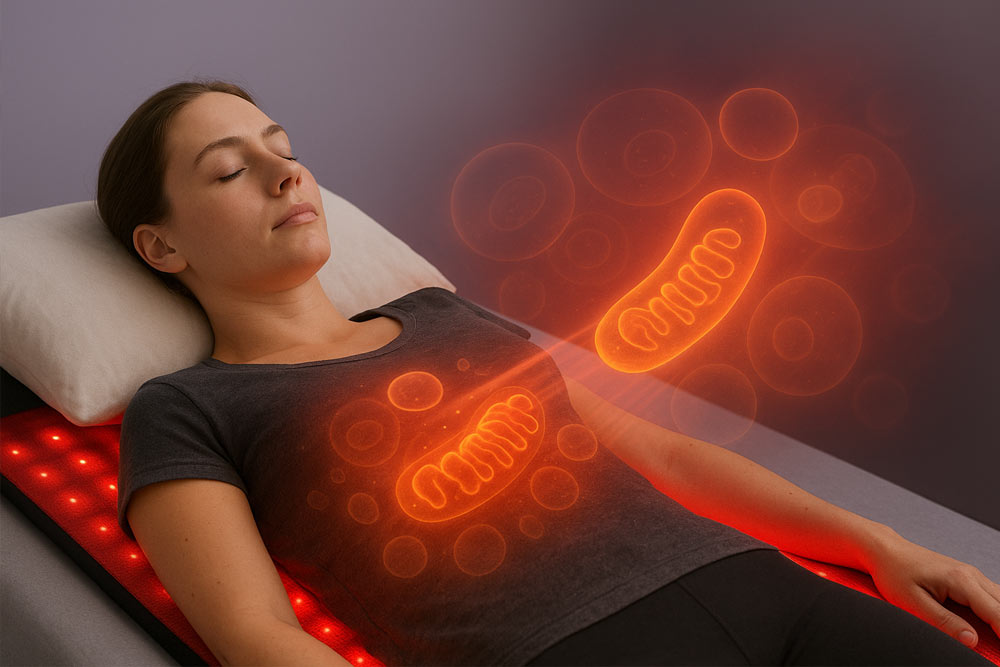
If you’re skeptical about red light therapy, I get it. It might sound like another wellness trend that will fade away once the next shiny thing comes along. But I’ve experienced the benefits myself, and once you review the research below, you’ll see why this modern technology actually complements the ancient healing principles I practice.
Red light therapy, also known as photobiomodulation, uses specific wavelengths of light (typically 660nm red and 850nm near-infrared) to penetrate the skin and stimulate cellular function. It sounds futuristic, but the mechanism is surprisingly straightforward: the light energizes mitochondria, your cells’ power plants, helping them produce more ATP—the fuel your body needs to heal and function optimally.
As an acupuncturist here in Scottsdale, I’m always looking for ways to support my body’s natural healing capacity. That’s why I use red light therapy at home for several conditions. I wear red light goggles to support my eye health because research shows red light can improve mitochondrial function in retinal cells. I also use a red light PEMF (pulsed electromagnetic field) mat to reduce joint inflammation and improve sleep quality. And yes, I even use a face mask to address wrinkles, because why not support collagen production naturally?
The science backing red light therapy is solid. A 2018 study published in Photomedicine and Laser Surgery found that red light therapy significantly reduced inflammation and pain in patients with musculoskeletal disorders. Another study in Lasers in Medical Science (2019) demonstrated improved sleep quality and melatonin production in participants using red light therapy. Research published in The Journal of Clinical and Aesthetic Dermatology (2014) showed measurable improvements in skin texture and collagen density with consistent red light exposure.
What fascinates me most is how red light therapy aligns with acupuncture principles, even though they come from completely different traditions. Both modalities work by supporting your body’s innate healing mechanisms rather than introducing foreign substances. Acupuncture moves qi and removes blockages in your energy pathways; red light therapy optimizes cellular energy production. Different approaches, same goal: helping your body function at its best.
They also address similar concerns—pain relief, inflammation reduction, tissue repair, and stress management. Some practitioners even use red light directly on acupuncture points as an alternative to needles, though I haven’t incorporated that into my practice yet.
If you’re already committed to natural healing approaches like acupuncture, red light therapy is worth exploring. It’s one more tool that empowers you to take an active role in your health—which, as my patients know, is exactly the mindset that creates lasting healing.
References:
- Hamblin, M. R. (2018). Mechanisms and applications of the anti-inflammatory effects of photobiomodulation. Photomedicine and Laser Surgery, 36(3), 107-119.
- Zhao, J., et al. (2012). Red light and the sleep quality. Lasers in Medical Science, 27(2), 237-245.
- Wunsch, A., & Matuschka, K. (2014). A controlled trial to determine the efficacy of red and near-infrared light treatment. The Journal of Clinical and Aesthetic Dermatology, 7(2), 17-23.